
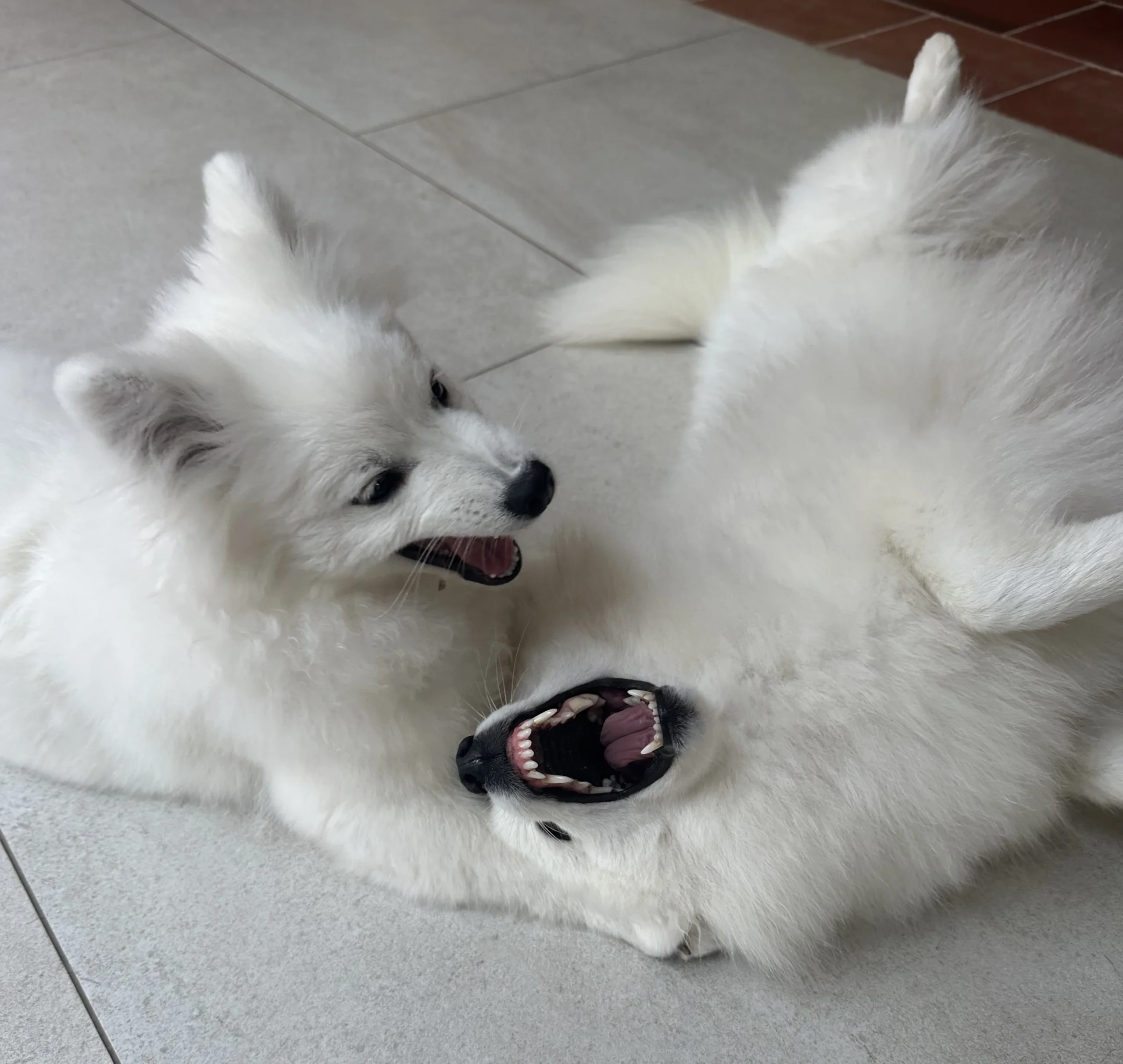
There is a rather unhelpful idea in the dog world that socialisation is something we do to puppies before a mysterious door slams shut at around sixteen weeks of age. Get everything right before then, we are told, and the puppy will sail serenely through life. Miss the opportunity, and apparently all is lost.
Fortunately, canine development is both more complicated and more hopeful than that.
The early socialisation period is undeniably important. A young puppy’s experiences help to shape their expectations of people, animals, places, sounds, surfaces and events, and thoughtful exposure during this stage can create a valuable foundation for later life. However, socialisation is not a collection of boxes to be ticked before puppyhood ends, nor is it a lifetime guarantee that a dog will continue to feel exactly the same way about everything they encountered when they were small.
Dogs continue to develop, learn and reassess the world throughout adolescence and beyond. In fact, adolescence is often the point at which owners discover that the confident, sociable puppy they thought they knew has apparently been replaced by someone altogether more complicated.
What happens to dogs during adolescence?
Adolescence is not simply a larger version of puppyhood. It is a significant developmental stage involving physical growth, hormonal changes, neurological development and increasing behavioural independence.
The precise timing varies according to the individual dog, their breed and their expected adult size. Smaller dogs may move through some developmental stages earlier, while large and giant breeds can remain behaviourally immature for considerably longer. There is no single birthday on which a puppy officially becomes an adolescent, and development rarely happens in a neat, predictable line.
An adolescent dog may appear confident one week and uncertain the next. They may suddenly notice things they previously ignored, become more selective about other dogs, react more strongly to movement or noise, or seem less able to respond to familiar cues when the environment becomes exciting.
This does not necessarily mean that their early socialisation has failed, that the dog is being stubborn, or that the owner has done something wrong. It often means that the dog is processing familiar experiences through a changing adolescent brain.
One of the most useful things we can do during this period is to stop asking, “Why has my training gone backwards?” and begin asking, “What does my dog need from me at this stage of development?”
Socialisation is not the same as socialising
The word socialisation is frequently misunderstood. It does not mean allowing a dog to greet every person or play with every dog they encounter. It certainly does not mean repeatedly placing them in intense social situations in the hope that they will somehow become more sociable.
Good socialisation is about helping a dog develop the emotional and behavioural skills needed to cope with the world around them. Sometimes that will include friendly interaction. At other times, it will mean learning to observe something calmly, pass it at a comfortable distance or recognise that it is safe to disengage and move away.
A well-socialised dog does not need to love everybody.
They need to feel sufficiently safe, supported and equipped to navigate ordinary life without being repeatedly overwhelmed.
This distinction becomes especially important during adolescence, when many dogs naturally become more discerning about who they wish to interact with. A puppy who once rushed enthusiastically towards every dog may begin to prefer particular playmates, feel uncomfortable with boisterous strangers or simply lose interest in greeting unknown dogs altogether.
That change is not automatically a problem. Social maturity frequently brings greater selectivity, and it is perfectly reasonable for an adolescent dog to decide that they do not want to be everybody’s best friend.
When confidence suddenly seems to disappear
Owners are often taken aback when an adolescent dog becomes worried by something they have seen many times before. A wheelie bin, a person in unusual clothing, a dog barking behind a fence or an unfamiliar object on a familiar walking route may suddenly provoke hesitation, barking or retreat.
The temptation is to demonstrate that the object is harmless by moving closer, encouraging the dog forward or persuading them to investigate. Unfortunately, this can turn a moment of uncertainty into a much more significant experience.
When a dog is worried, distance is not defeat. Distance is information.
Moving far enough away for the dog to look, think and recover can prevent them from becoming overwhelmed. From that safer position, we can help them form a better association with what they have noticed, while preserving their sense of choice.
An adolescent dog who pauses at the sight of something unfamiliar does not necessarily need to be coaxed towards it. They may need time to watch it. They may need the opportunity to move in an arc rather than approach directly. They may need to retreat, sniff, gather information and try again another day.
Confidence is not created by removing every avenue of escape. It grows when the dog discovers that they can encounter something uncertain and remain safe.
Why “more exposure” can make matters worse
When a dog appears worried, reactive or socially uncertain, the advice owners often receive is that the dog “needs more socialisation”. This can lead to a frantic programme of busy walks, dog parks, cafés, crowded events, play sessions and increasingly close encounters.
More is not always better.
Exposure only helps when the dog is able to process the experience without becoming excessively frightened, frustrated or over-aroused. If the dog is repeatedly overwhelmed, they are not learning that the situation is safe. They may instead be learning that the appearance of another dog, an unfamiliar person or a busy environment predicts loss of control and emotional discomfort.
The quality of an experience matters far more than the number of experiences collected.
A calm five-minute observation from a comfortable distance may be considerably more useful than an hour spent struggling through a crowded environment. A walk with one socially skilled companion may teach more than an uncontrolled free-for-all involving several unfamiliar dogs. Quietly watching people outside a shop may be more productive than being encouraged to accept attention from everyone who passes.
Socialisation should not be measured by how much the dog has endured. It should be judged by what the dog has learned.
Learn to notice the quieter signs
Adolescent dogs do not always announce discomfort dramatically. Long before barking, lunging, growling or trying to escape, a dog may show much subtler changes in posture, movement and facial expression.
They may slow down, turn their head away, shift their weight backwards, close their mouth, lick their lips, lower their body, become suddenly still or begin scanning the environment. Some dogs move closer to their owner, while others become intensely interested in sniffing the ground. A dog who appears “distracted” may actually be trying to regulate themselves or avoid direct engagement with something they find difficult.
This is why knowledge of canine body language is so important. When we recognise the early signs of uncertainty, we can respond before the dog has to escalate their behaviour. My flagship Learn to Talk Dog programme explores these subtle signals in depth, helping owners and professionals understand what dogs are communicating before those signals develop into more obvious behaviour.
Waiting for the bark or lunge means waiting until the dog is already struggling. Noticing the tiny changes that come first gives us far more opportunity to help.
Adolescents still need carefully chosen social experiences
None of this means that adolescent dogs should be protected from every challenge or kept away from the world. Avoiding all novelty can limit learning just as surely as overwhelming exposure can.
The aim is thoughtful, graduated experience.
Choose environments in which you can control distance and leave easily. Allow the dog time to observe before deciding whether interaction would be helpful. Pair unfamiliar experiences with things the dog genuinely values, while remembering that a dog who is too worried to eat may already be too close or under too much pressure.
Consider the skills the dog needs, rather than simply the situations you would like them to tolerate. Can they turn away with you? Can they check in with you without being repeatedly prompted? Can they settle and observe? Can they move past something without greeting it? Can they recover after being startled?
These practical coping skills form an essential part of adolescent social development. A dog who knows how to disengage and move away has options other than escalating into barking or lunging.
For a deeper exploration of what is happening during this developmental stage, my Socialisation in Adolescence webinar looks specifically at social development during adolescence and how we can support dogs as their responses to the world begin to change.
Be selective about canine companionship
Adolescent dogs can learn a great deal from other dogs, but the identity and behaviour of those dogs matter enormously.
A socially skilled adult dog may communicate clearly, allow pauses and help an adolescent practise appropriate interaction. By contrast, an overly persistent or physically intense dog may teach the adolescent that social encounters are unpredictable, inescapable or unpleasant.
Not every dog needs a large circle of canine friends. Some benefit much more from a small number of compatible companions. Others may enjoy walking alongside another dog without wanting physical play.
Watch what happens during the interaction rather than assuming that all play is beneficial. Are both dogs repeatedly choosing to return? Are there natural pauses? Can either dog move away without being pursued? Is one dog doing most of the chasing, pinning or body contact? Does the adolescent appear loose and engaged, or are they becoming increasingly frantic, defensive or exhausted?
Successful social experience depends on mutual choice, not simply proximity.
Give the adolescent dog some control
Choice is often treated as an indulgence in dog training, yet an appropriate degree of control can be profoundly important to emotional wellbeing.
Allowing a dog to move away from an uncomfortable interaction does not teach them to be fearful. It teaches them that their communication works and that their trusted person will listen.
This, in turn, can reduce the need for more dramatic behaviour.
When early signals are ignored, dogs may discover that turning away, freezing or hiding behind their owner achieves nothing. Barking, lunging or snapping may then become the only strategies that reliably create distance.
Listening sooner is not “giving in”. It is good risk management and good communication.
Of course, dogs cannot control every aspect of life. There will be veterinary visits, necessary journeys and unexpected events. However, giving them choice where choice is possible can make the unavoidable parts of life much easier to manage.
Keep training realistic during adolescence
Adolescent dogs are often described as disobedient because their responses become less reliable in distracting environments. Yet a dog who can perform a behaviour beautifully in the kitchen has not necessarily learned to do it beside a football pitch, outside a school or in the presence of another dog.
The environment is part of the cue.
Instead of assuming that the dog “knows it really”, we need to continue teaching and proofing behaviours gradually. That means practising in different places, at different distances from distractions and at levels of difficulty where the dog can still succeed.
This period is not the time to abandon reinforcement because the dog is old enough to know better. It is the time to make reinforcement more relevant, improve our timing and recognise that the outside world may currently be offering fierce competition.
Food can be useful, but it is not the only reward. Moving away, being released to sniff, gaining access to a favourite activity, continuing the walk or being allowed to greet a familiar friend can all reinforce behaviour when used thoughtfully.
The adolescent dog is not giving us a hard time. They may be having a hard time—and our job is to make the desired response possible, worthwhile and well practised.
Protect the relationship
Adolescence can be a challenging stage for owners. The small, dependent puppy has become stronger, faster and more opinionated, while the skills that seemed secure can suddenly appear unreliable. It is easy for frustration to creep into the relationship.
However, this is precisely when the dog needs consistency, clarity and emotional safety.
Punishing an adolescent for communicating discomfort may suppress the visible warning without changing the underlying emotion. Correcting barking, growling or avoidance can create a dog who feels just as worried but becomes less willing to show it until the situation is much more serious.
Behaviour is information. Even when it is inconvenient, it tells us something about the dog’s emotional state, expectations, learning history or ability to cope in that moment.
That does not mean allowing unsafe behaviour to continue. It means managing the situation, creating distance where necessary and teaching a safer alternative, rather than treating the communication itself as the enemy.
Socialisation is a continuing conversation
The goal of socialisation is not to manufacture a dog who is endlessly tolerant, relentlessly friendly and unaffected by every experience. Real dogs have preferences, sensitivities, histories and changing needs.
The confident puppy may become a thoughtful adolescent. The indiscriminately sociable youngster may grow into an adult with a small, carefully selected friendship group. The adolescent who suddenly becomes worried by unfamiliar things may regain confidence when given time, distance and well-designed support.
Development does not end when the puppy socialisation checklist does.
Our task is to continue observing the dog in front of us, adapting the environment and providing experiences that build competence without sacrificing trust. When we understand adolescence as a developmental process rather than a training failure, it becomes much easier to respond with curiosity instead of frustration.
Socialisation is not something we finish.
It is an ongoing conversation between the dog, the environment and the person they rely upon to help them make sense of both.
About Sarah Whitehead
Sarah Whitehead MSc is a Certified Clinical Animal Behaviourist, international lecturer, author and specialist in canine and feline body language, with more than 35 years’ experience in animal behaviour and training. She is particularly known for helping owners and professionals recognise the subtle signals that reveal how dogs are feeling before behaviour escalates.
Sarah’s flagship Learn to Talk Dog programmes explore canine body language, facial expression and dog-to-dog communication in depth, helping learners move beyond broad labels such as “friendly”, “stubborn” or “aggressive” and understand what an individual dog is actually communicating.
Sarah’s Socialisation in Adolescence webinar provides further learning specifically on the developmental changes that occur during adolescence and how these can influence a young dog’s social behaviour and responses to the world.
